The Repair Receipt I Kept: Six Pairs, One Cobbler, and a New Rule for Winter Shopping
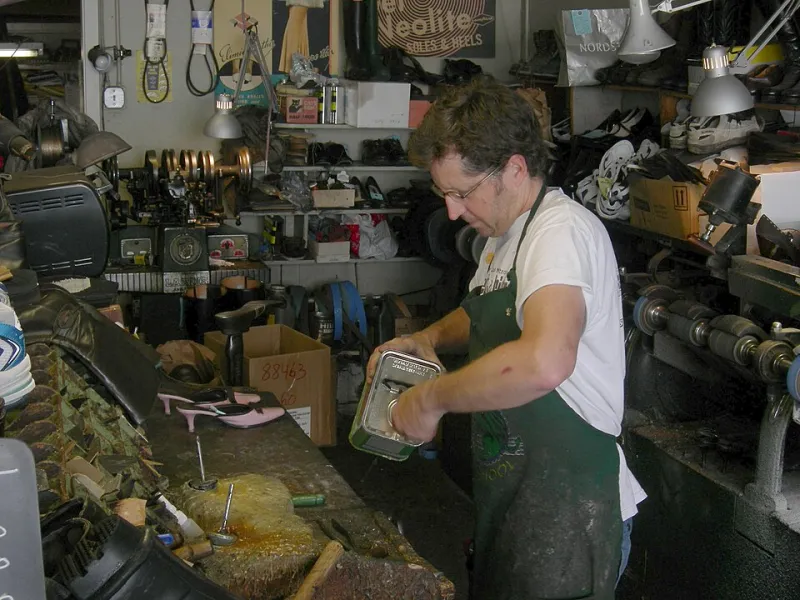
Photo: Joe Mabel, CC BY-SA 3.0, via Wikimedia Commons
On a grey Tuesday in November, I carried a canvas tote containing six pairs of winter shoes to a cobbler two streets from my flat. The bag was heavy with things I had been avoiding: ankle boots with heels worn to a slant, knee-high boots with a zip that snagged, suede Chelsea boots that had met one too many pavement puddles. The quote came back at £45. Not for every pair - for the four repairs that made sense. That receipt has done more for my winter wardrobe than any new-in edit.
The six-pair audit
I laid them out on the counter like a shameful little lineup. The cobbler picked each one up, turned it over, pressed the sole with his thumb and gave a verdict in about ninety seconds per pair. The short version:
- Black leather ankle boots: heel tips worn down to the nail. Fixable, £12. Verdict: save.
- Knee-high boots: zip slider and top stop failing, sole still solid. Repair quoted at £18. Verdict: save, but only because the leather was good.
- Suede Chelsea boots: scuffed toe, worn heel, no structural damage. Reheel at £10. Verdict: save.
- Leather loafers: loose stitching along one side. £5 to restitch. Verdict: save.
- Old lace-up boots: cracked synthetic sole and a split across the flex point. £48 to resole, with no guarantee it would hold. Verdict: let go.
- Canvas trainers: sole worn through at the heel. Cobbler shook his head. Verdict: not a cobbler job.
The bill for the four keepers came to £45 once he knocked off a few pounds for doing them together. The two rejects went to the textile bank and the bin respectively. No ceremony, no guilt.
What the £45 actually covered
This is the part that matters. A repair bill is only useful if you know what you are buying. Mine broke down like this:
- £12 for new heel tips on the ankle boots. That is a small piece of rubber or plastic at the base of the heel, not a full reheel. It is the cheapest way to stop a good upper from tilting into an unwearable shape.
- £18 for a zip repair on the knee-highs. The cobbler replaced the slider and top stop rather than the whole zip. That is a common fix and much cheaper than a full zip replacement, which can run £30 or more.
- £10 for a reheel on the suede Chelsea boots. He matched the heel colour closely enough that I cannot spot the difference from a pavement-level glance.
- £5 for restitching the loafers. A five-minute job for him, a saved pair for me.
The full resole on the lace-up boots would have been the single most expensive item on the list. It was also the least certain. A cobbler can replace a sole, but he cannot rebuild the collapsed structure inside a cheap boot. When the upper is already splitting at the flex point, a new sole is just a fresh foundation on a crumbling house.
The cost-per-wear maths I should have done sooner
I am not a spreadsheet person by nature, but cost per wear is simple enough to do on the back of a receipt. The formula is: total cost divided by number of wears.
Take my black ankle boots. They cost £95 and I have worn them roughly 120 times. That is about 79p per wear. Add the £12 repair and assume it buys me another 40 wears. The new maths is £107 divided by 160 wears, which is about 67p per wear. A replacement pair at £110, worn 120 times, would be 92p per wear. The repair wins - not by a dramatic margin, but enough to matter.
The knee-high boots are the clearer case. They were £140 and have been worn at least 80 times, so £1.75 per wear. An £18 zip repair that gets me through another 30 wears brings the total to £158 divided by 110 wears, or £1.44 per wear. A new pair of equivalent leather boots in 2026 is easily £160 to £200. Suddenly the repair looks less like maintenance and more like a small act of financial sense.
My rough rule now: if a repair costs less than a third of a replacement and buys me at least one more season, it is usually worth doing. If it costs half the price of new and the upper is already tired, I need a very good reason to say yes.
What a cobbler can fix - and what they cannot
A good shoe repairer is not a miracle worker. They are a practical one. In the UK, most local cobblers can handle heel tips, full soles on leather boots, zip sliders and top stops, stitching, stretching, toe plates and small patches. Many will also clean and protect suede or leather, though results vary.
They cannot reliably save cracked polyurethane soles, mould that has gone into the lining, broken shanks inside the sole, or synthetic uppers that are peeling away from the base. Some can replace buckles and straps; some will not touch trainers because the sole construction is glued rather than stitched. A good cobbler tells you when to stop. A bad one takes the money and hands back a pair that fails in a fortnight.
How to spot a repair worth paying for
Ask for the quote before the work starts, and ask what exactly is being replaced. 'Heel tips' and 'a full reheel' are different jobs with different prices. Ask what material the new sole or heel will be, and whether the repair will change how the shoe fits or feels. If a cobbler cannot explain the fix in plain English, walk away.
Look at the stitching on the finished repair. It should be neat, tight and matched to the original as closely as possible. Ask whether they will seal or polish the edges. A small extra step often makes the difference between a repair that blends in and one that announces itself every time you cross your legs.
And do not underestimate the value of a second opinion. The first cobbler I tried quoted £65 for the same four jobs. The second quoted £45 and explained why the lace-up boots were not worth saving. That explanation was worth as much as the discount.
The £45 did not save every pair. It saved the ones that deserved it. That is the point. A repair bill is not a sentimental rescue mission; it is a filter. It tells you which parts of your winter wardrobe are still doing their job, and which ones you have been carrying out of habit.
I still want new boots. I am just no longer in a rush to buy them. The ones I already own have had their second chance, and the receipt is staying on the fridge.