Standing Still Is the Hardest Part: A Christmas Market Outfit Post-Mortem
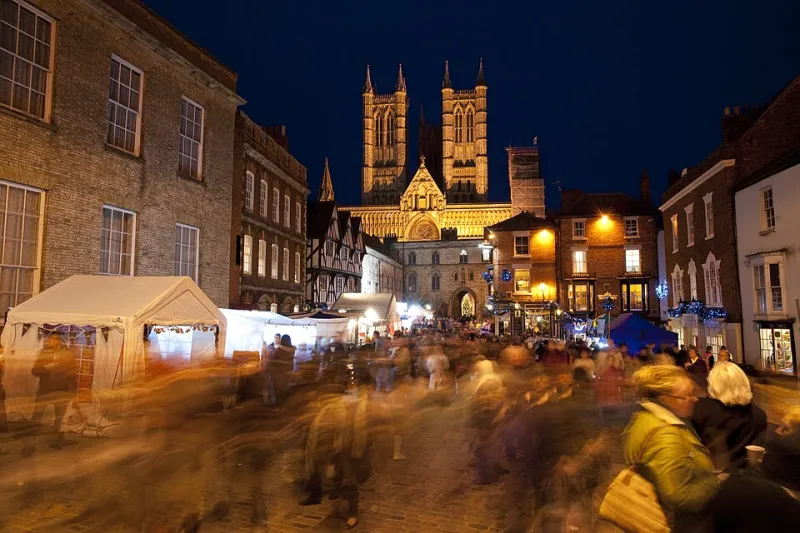
Photo: Virgin Trains East Coast, CC BY 3.0, via Wikimedia Commons
Christmas markets are a strange dress code. You are outdoors for hours, but you are not walking in the way a normal walk works. You are shuffling, stopping, queuing, holding a cup, stepping around a puddle, then standing still again while someone decides between two wooden snowmen. Last Saturday I gave one outfit the full field test at a market in the Midlands: cold car park, drizzle, bratwurst smoke, mulled wine, and a slow three-hour loop. The question wasn’t whether it looked nice when I left the house. It was whether it still looked like an outfit by the time I got back to the car.
The brief
I wanted one outfit that could do the whole afternoon without a backup plan. No changing in the car, no emergency scarf left in the boot, no shoes that would make me walk like a newborn deer on wet cobbles. It had to be warm enough for standing about in roughly 6°C, comfortable enough for three hours of stop-start wandering, and tidy enough that I didn’t feel like I’d given up on myself in public.
What I wore
My starting point was a thin thermal long-sleeve top and thermal leggings under everything. Over that went a fine-gauge merino jumper, a cord midi skirt, and 80-denier opaque tights. I wore flat Chelsea boots with a chunky rubber sole and a mid-length wool coat. Accessories were a wool scarf, a knit hat, leather gloves and a small crossbody bag. Nothing clever. Nothing new. Just pieces that already live in my wardrobe and usually behave.
Warmth: where the cold actually got in
The core was fine. Thermals plus merino plus wool coat kept my torso genuinely warm, even when we stopped for ten minutes to watch a choir murder a Mariah Carey song. The scarf did its job around my neck, and the hat made more difference than I expected. The weak points were my feet and my lower back. My toes went from fine to quietly furious at around the two-hour mark, and the gap between my coat hem and my boots let in a draught every time I stood still. Next time I’d wear thin merino socks under the tights, not just tights alone, and I’d make sure the coat was fully buttoned rather than flapping open for the sake of looking relaxed.
Comfort: the standing-still problem
This is the bit I always underestimate. Walking keeps you warm and distracted. Standing still makes you notice every seam, every waistband and every shoe. The midi skirt was a good call because it didn’t cling when I sat down on a damp bench, and the crossbody bag kept my hands free for mulled wine and the inevitable paper napkin. The boots were stable on wet paving, which is more than I can say for some of my smarter winter shoes. What I’d change is the bag size. Mine was just small enough to make gloves, phone and a purse feel like a game of Tetris. A slightly bigger crossbody with a proper zip would have been less fiddly in the crowd.
The look after three hours
This is the real test, isn’t it? By hour three I had a faint mulled wine ring on one cuff, a damp hem from the car park, and the kind of hair that suggests I’d been standing near a hot food stall for too long. But the outfit still looked deliberate. The coat held its shape, the skirt hadn’t creased into oblivion, and the boots had done their job without turning my feet into a cautionary tale. The scarf was the weak link aesthetically: it went from cosy to bulky somewhere between the second and third queue, and I kept re-wrapping it like a woman trying to secure a roof in a storm.
What I’d change next time
I’d take a slightly larger crossbody bag and a thinner scarf. I’d wear merino socks under the tights. I’d also skip the second jumper I’d packed in the car as a just-in-case layer, because I never used it and it just made me feel over-prepared in a way that led to over-dressing. The boots would stay. The skirt would stay. The thermals would absolutely stay. The overall formula was right; it just needed a small tune-up rather than a full re-think.
The one swap that made the biggest difference
The surprise winner was adding a thin, packable insulated gilet under the wool coat instead of a second jumper. I borrowed one halfway through the afternoon and it changed everything. It added warmth across my middle without adding bulk at the shoulders, so my coat still hung properly and I could still move my arms without feeling like a Christmas decoration. It was not the most elegant moment of my life, but it was the difference between shivering through the last hour and happily standing in one more queue for roasted chestnuts. That’s the swap I’d build into the outfit next time: thin layer underneath, wool coat on top, no extra bulk around the neck.
Shop-your-wardrobe checklist
Before the next market, I’d run through this list rather than buying anything new:
- A thin thermal top and leggings you already own.
- A fine-gauge jumper that fits under your coat without bunching.
- A midi skirt with enough room to sit down and stand up without adjusting.
- Opaque tights plus thin merino socks, not one or the other.
- Flat boots with a grippy sole and enough room for socks.
- A wool coat you can button properly, not just wear open for the look.
- A crossbody bag big enough for gloves, phone, purse and a tissue.
- A thin insulated gilet or liner layer for the standing-still bits.
- A scarf that stays put when you’re holding a cup and a napkin at the same time.
The Christmas market outfit isn’t about looking festive from a distance. It’s about still feeling like yourself after three hours of cold air, crowd shuffling and a muddy car park. Mine mostly worked. Next time, it’ll work better.